Industrial Coolers and Chillers Made With Food Grade Stainless Steel: The 2026 Technical Guide to Thermal Management
[TL;DR / Key Takeaways]
|
Industrial Coolers and Chillers Made With Food Grade Stainless Steel: The 2026 Technical Guide to Thermal Management
Introduction: Why Thermal Control Defines Product Quality
In the industrial landscape of East Africa, where ambient temperatures can fluctuate significantly, the ability to control the temperature of your product is the difference between a high-value output and a total loss. Whether you are running a dairy cooperative in the Rift Valley or a juice processing plant in Nairobi, the “Cooler” is your primary defense against spoilage.
Thermal management in 2026 is no longer just about “keeping things cold.” It is about rapid heat extraction. Every minute a product remains at a lukewarm temperature is a minute that bacteria can multiply or chemical reactions can go off-course. Industrial-grade coolers and chillers made with food grade stainless steel provide the mechanical precision required to hit target temperatures quickly and maintain them with minimal energy waste, even during the hottest months of the year.
Also Read About: Industrial Stainless Steel Mixing Tanks
1. Understanding the Mechanics of Industrial Cooling
To select the right equipment, it is important to understand how these systems move heat. In technical terms, a chiller does not “produce cold”; it utilizes a refrigerant to absorb heat from the product and discharge it into the environment.
The Refrigeration Cycle
Industrial cooling typically happens through two main methods:
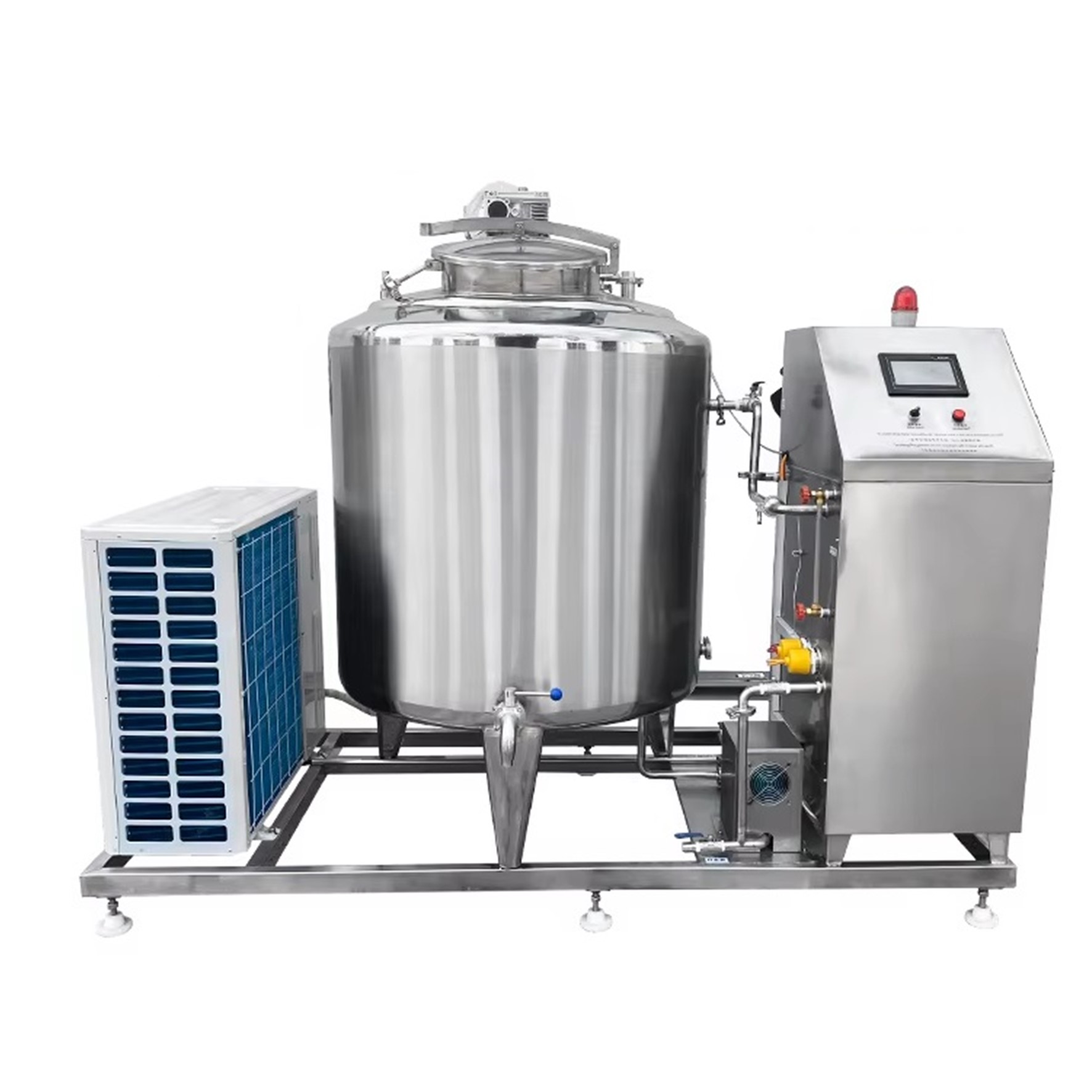
- Direct Expansion (DX): The refrigerant flows through a copper coil located directly in the jacket of the tank. This is common in Bulk Milk Coolers (BMCs) where the tank itself is the refrigerator. It is highly efficient for cooling a fixed volume of liquid in one place.
- Indirect Cooling (Glycol Systems): A central chiller cools a mixture of water and food-grade propylene glycol. This “coolant” is then pumped through the jackets of various mixing tanks or pasteurizers throughout the factory. This is the preferred setup for large-scale production lines with multiple cooling points.
2. Key Components of a High-Performance Chiller
A reliable cooling system is built from high-grade industrial components designed for 24/7 operation.
The Compressor (The Engine)
The compressor is responsible for moving the refrigerant through the system. We utilize world-class scroll or reciprocating compressors that are rated for high-ambient conditions, ensuring they don’t trip or fail when the factory floor gets hot.
The Heat Exchanger (Evaporator)
In a chiller, the heat exchanger is where the “magic” happens. In our stainless steel fabrications, we use high-surface-area dimple jackets or internal coils to ensure the maximum amount of product touches the cooling surface, leading to faster cooling times.
High-Density Insulation
Cooling a liquid is expensive; keeping it cold should be cheap. Our tanks are wrapped in 50mm to 100mm of high-density PUF insulation. This ensures that even if the power goes out for 8–12 hours, the temperature rise is limited to less than 2°C, protecting your inventory from spoilage.
3. 2026 Market Pricing for Cooling Systems in Kenya
The investment required for cooling equipment depends on the “Cooling Load”—how much liquid you need to cool and how fast you need to do it.
| System Type | Capacity | Primary Application | Estimated Price (KSh) |
| Bulk Milk Cooler (Open) | 500 Liters | Small Dairy Farms | 380,000 – 450,000 |
| Bulk Milk Cooler (Closed) | 2,000 Liters | Dairy Cooperatives | 850,000 – 1,100,000 |
| Industrial Glycol Chiller | 5HP – 10HP | Beverage/Pharma Plants | 650,000 – 950,000 |
| Instant Milk Chiller | 1,000 L/h | High-Speed Intake Lines | 1,200,000+ |
Pro Tip: Always consider the “Recovery Time.” A cheaper unit may take 5 hours to cool a batch, whereas a correctly sized industrial unit will do it in 2 hours, saving you thousands in electricity and potential bacteria-related losses.
4. Design Standards: Hygiene and Durability
Because coolers often interact with food products (milk, juice, beer), the construction must meet strict sanitary standards.
- Grade 304 Stainless Steel: This is the non-negotiable standard. It does not rust, is easy to sanitize, and does not react with the lactic acid in dairy or the fruit acids in beverages.
- Automatic Agitation: To prevent “icing” on the tank walls and to ensure the liquid is cooled uniformly, our tanks feature automated, low-speed agitators. These move the liquid gently to prevent damage to fat globules (in milk) while maximizing heat transfer.
- Digital Control Panels: Modern systems are equipped with programmable logic controllers (PLCs). You can set your target temperature (e.g., 4°C), and the system will automatically cycle the compressor on and off to maintain that precise level, reducing wear and tear.
5. Maintenance and Troubleshooting for 2026 Systems
A chiller is a mechanical system that requires regular attention to maintain its “Energy Efficiency Ratio” (EER).
- Condenser Cleaning: In Kenya’s dusty environment, the condenser coils (the part that looks like a car radiator) get clogged quickly. If air cannot move through these coils, the compressor works twice as hard and eventually burns out. Clean these weekly with compressed air or a soft brush.
- Refrigerant Levels: A small leak can cause the system to lose its cooling power. If you notice the compressor running constantly but the temperature isn’t dropping, have a technician check the gas levels.
- Glycol Concentration: For indirect systems, the water-to-glycol ratio must be checked every 6 months. If the glycol is too diluted, the water can freeze inside the pipes, causing them to burst.
- Seal and Gasket Health: Check the lid seals of your coolers. A faulty seal allows cold air to escape and warm, contaminated air to enter the tank.
6. The Business Case: Why Quality Cooling is a Profit Center
Many business owners view cooling as a “cost,” but it is actually a primary driver of profit:
- Grade Premium: In the dairy industry, milk with a lower bacterial count (thanks to rapid cooling) often fetches a higher price per liter from processors.
- Waste Reduction: Proper chilling eliminates “sour” batches and product recalls, which can bankrupt a small processing startup.
- Energy ROI: Investing in a system with superior insulation and a modern compressor can save a factory over KSh 300,000 per year in electricity bills compared to using refurbished or poorly insulated second-hand units.
7. Why Raydan is Kenya’s Thermal Engineering Leader
Raydan Stainless Steel Fabricators specializes in custom cooling solutions that are built for the local climate. We understand the challenges of power fluctuations and high ambient heat.
- Over-Engineered Condensers: Our systems feature larger-than-standard condensers to ensure they perform perfectly even in North Eastern or Coastal heat.
- Turnkey Installation: We handle everything from the stainless steel tank fabrication to the copper piping and final commissioning.
- Rapid Response: With our team in Nairobi, you never have to worry about long downtimes. We stock spare parts for all our compressors and controllers.
Industrial Coolers and Chillers Made With Food Grade Stainless Steel – People Also Ask (FAQ)
- What is the difference between a milk cooler and a chiller?
A milk cooler is usually a storage tank with an integrated cooling system (Direct Expansion). A chiller is a standalone machine that produces cold fluid (usually glycol) to cool other machines or tanks. - Can I use a milk cooler for other beverages?
These tanks are excellent for cooling juices, wine, or even chemicals, provided the acidity of the liquid is compatible with Grade 304 stainless steel. - How much power does a 2,000L milk cooler use?
A 2,000L unit typically requires a 3-phase power connection and consumes roughly 3–5 kWh during the initial cooling phase, dropping significantly once the “holding” temperature is reached. - How long can a tank hold the temperature during a blackout?
Thanks to our high-density PUF insulation, a well-sealed Raydan tank will lose less than 1°C every 8 hours, giving you ample time to restore power or start a generator. - Do you offer solar-powered cooling?
While full solar cooling for large industrial loads is complex, we can design “Hybrid” systems that utilize solar power for agitation and control systems, reducing your overall grid dependency.
Call to Action: Control Your Temperature, Control Your Quality
Don’t let the heat destroy your hard work. Invest in a thermal management system that is built to last and engineered for the highest efficiency in the East African market.
Contact Raydan Stainless Steel Fabricators Today:
- Call/WhatsApp: +254 798 70 30 77 | +254 707 307 451
- Email: customercare@raydanstainlesssteelfabricators.co.ke
- Visit Us: Enterprise Road, Industrial Area, Nairobi.